

Piggy Heist by Play’n GO: bonus hunt logic, money symbols, and how the slot shifts into bigger payouts
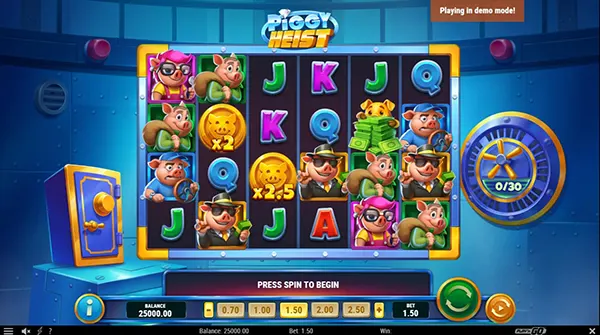
Piggy Heist is a Play’n GO slot that looks straightforward on the surface, yet its real payout potential is driven by a very specific rhythm: coin values appear, collectors sweep them, and a Hold’n Spin-style bonus can lock the screen and keep extending until it stops landing new value. The game runs on a 6×4 grid with 4,096 ways to win. It’s commonly described as medium volatility, but it also carries a very high maximum win potential, which is why it attracts attention from players who focus on bonus features and money-symbol mechanics.
Core mechanics: reels, RTP variants, and why the base game matters for a bonus hunt
Piggy Heist uses a 6-reel, 4-row layout with 4,096 ways, so it doesn’t behave like classic fixed-payline slots. Wins are formed from left to right, and the grid size means you often see plenty of symbol movement without constant line payouts. This is intentional: the base game is designed to generate coin value and then reward you when the collection mechanics land at the right time.
As of 2026, a key detail about Piggy Heist is that it exists in more than one RTP configuration. Many sources reference an RTP around 96.25%, but operators can choose different versions, including lower settings. That means two players can be playing the same title with different expected long-term returns depending on the casino’s configured RTP. The most reliable way to confirm this is by checking the game’s internal information or rules section, where the active RTP is typically displayed.
The betting range is usually broad enough to suit both low-stake sessions and higher-stake spins. This matters because bonus hunting is rarely about triggering a feature just once. It’s usually about staying long enough in a session where the base game is producing consistent coin activity, so the mechanics have enough “fuel” to build meaningful wins.
Bonus hunt mindset: what you’re actually hunting in Piggy Heist
In many slots, the logic of a bonus hunt is simple: trigger the feature and hope for a strong payout. In Piggy Heist, the hunt is more specific. The key is not only triggering the bonus, but finding a session where coin values are landing regularly and collectors appear often enough to convert those values into wins. If coins are rare in the base game, even a triggered bonus can feel flat because there hasn’t been enough value generation.
Another important point is that Piggy Heist can deliver strong outcomes outside the bonus. Because coin values can appear and remain relevant until collected, the base game can produce sudden jumps when collectors land on a screen already loaded with coin symbols. This is why players often describe the game as “waking up” after a quiet stretch, even without a feature trigger.
From an analytical perspective, a productive bonus hunt in Piggy Heist is not about the fastest trigger. It’s about observing whether the base game is producing enough coin density and enough collection events to create multiple routes to profit, with the bonus being only one of those routes.
Money symbols and collection logic: coins, collectors, and why timing changes everything
The main money symbols in Piggy Heist are coin icons with printed values, usually shown as stake multipliers. These symbols are different from standard line wins because they don’t automatically pay just for appearing. Their purpose is to create visible value on the grid that can later be collected, which makes the slot feel more transparent than games where everything is instantly resolved.
Collectors are the feature that turns those visible coin values into real payouts. When a collector symbol lands, it gathers the coin values currently on screen and adds them to the win. This is why timing matters so much. A collector that lands when the grid is mostly empty produces a minor result, but a collector that hits during a high-density coin screen can create a much larger payout.
The overall design encourages players to watch the flow of coin activity rather than treat each spin as a completely separate event. That doesn’t mean the game guarantees future wins, but it does mean you can evaluate whether the session is producing enough value to justify continuing, especially if you’re hunting for stronger collection moments.
How the slot shifts into bigger payouts: coin density, collector moments, and value compounding
The “shift” into bigger payouts in Piggy Heist typically happens when coin density builds up and collectors land while the grid is loaded. The slot is designed around value compounding rather than a single lucky line hit. When coin values start appearing in clusters, collectors become far more impactful, and a session can swing quickly from modest outcomes to significantly stronger hits.
This is why base-game observation is essential. If coin values are dropping often, the game gives you more chances for collection events to convert that stored value. If coins are scarce, collectors have less to work with, and you’re essentially relying on the bonus feature to change the session outcome.
A practical way to track this is to note how many spins occur without meaningful coin value appearing. Long dry stretches suggest the session isn’t producing the type of activity that usually supports bigger collector-driven payouts. It’s not predictive, but it keeps analysis grounded in what’s actually happening.
The bonus feature and big-win routes: Hold’n Spin structure and why extensions matter
The main bonus in Piggy Heist is a Hold’n Spin-style feature where coin values can lock into place and respins are used to fill more positions with additional value. These bonuses are often judged by one factor: whether they keep extending. The feature usually starts with a limited number of respins, and the counter resets when new value lands. A bonus that keeps resetting can run long enough to build a larger total before the final collection.
This structure is also why the game can support a very high maximum win potential. Even with an overall medium-volatility profile, the mechanics allow rare scenarios where the grid fills with strong values while the feature lasts long enough to stack them. Those are the rounds that create the largest wins and shape the slot’s reputation.
At the same time, it’s important to be realistic. Many bonus rounds will end quickly because new values stop landing, and without resets the feature closes before a meaningful screen build happens. The big-win path usually depends on sustained extension rather than a single instant trigger.
How to evaluate bonus performance without myths or hype
First, verify the RTP inside the game. Piggy Heist is available in multiple RTP configurations, and the active version can materially affect long-run results. For any factual analysis in 2026, it’s more responsible to remind players to confirm the RTP directly in the game’s info section rather than assume a single universal number.
Second, separate bonus frequency from bonus quality. It’s possible to trigger the Hold’n Spin feature several times and still underperform if respins don’t reset and locked coin values remain low. Strong bonuses are usually the ones that keep adding new values and keep the feature alive long enough to compound them.
Third, approach the game with structured observation rather than pure chasing. Cold stretches are normal, and a bonus hunt based on repetition alone can drain a bankroll quickly. A more grounded method is to watch coin density, track how often collectors appear, and treat the bonus as one of several payout routes rather than the only reason the slot can perform.